Saturday, July 27, 2013

The Most Special Foods Thats Only In Sarawak :D


  Kuching Sarawak is one of the heavens for food in Malaysia. You’ll get all sort of variety of delicious local Malaysian dishes. I got really carried away and bloated myself with all sort of food. Below is a short list of some of the food that I tried and recommend that you do too. They can be commonly available anywhere in Kuching town, but some of the dishes are only best if consumed at the recommended outlets.

Special foods,
http://mile.mmu.edu.my/orion/anisbalqis/files/2012/09/Sarawak_laksa.jpg
Laksa Sarawak! It is one of my favorite foods! :) Plus, this is in the month of Ramadhan, I'm sure all of you guys wanted to try it for Iftar. Unlike the Assam Laksa and Penang Laksa, the Sarawak Laksa has a taste of it’s own. Both sourish and spicy at the same time with a curry like zest to it give this dish a in my must try food in Sarawak. They are usually served in the morning as early as 6am so you’ll have to be early to get a good bowl. I tried the Sarawak Laksa at 2 spots, the tastier one was at Green Hill Corner Restaurant and the other was at the Sarawak Cultural Village. There are 3 main variations of laksa. Assam laksa, curry laksa and Sarawak Laksa. Assam laksa would be those laksa you can normally find in Penang or Ipoh. Curry laksa on the other hand is more commonly known as curry mee by Penangites, because they use yellow noodle/rice vermicelli instead of laksa noodle. In Singapore, they would be known as Katong Laksa. Also known as the ‘Great Borneo Breakfast’ Sarawak Laksa is most similar to curry mee in the main ingredient used: coconut milk. However it does not use curry powder but other spices for the taste. For Penangites, imagine a bowl of curry mee, with mee hoon only and lots of lime juice squeezed into the soup. That’s how Sarawak Laksa generally tastes. Yes, it’s a bit sour. A bowl of Sarawak Laksa would consist of rice vermicelli, taugeh, chicken strips, omelet strips, and big, fresh peeled prawns. It also comes with a lime, so you can squeeze as much lime juice as desired into the soup. I thoroughly enjoyed it, so it deserves a big thumbs up from me!
Mee Kolok

 Kolo Mee comes from the Hokkien Chinese culture and is quite a famous dish in Kuching Sarawak. You may want to try them at multiple stalls because they taste quite different. Basically Kolok Mee consist of Egg noodles that are flash-boiled, then classically served with crushed garlic and shallot and minced  beef. 


http://farm9.staticflickr.com/8003/7649353158_0572e5f4db_h.jpg


Terubok Masin is a salted 'terubok' fish (or American shad fish), a type of oily fish with lots of scales and Y-shaped bones. The fish can be either freshwater or seawater, local or imported, but local seawater 'terubok' fish costs more than other types.
Ikan Terubok Masin Sarawak is another Sarawak main food that mostly ordered and bought by visitors who came to Sarawak. This is salted fish which can be eaten with rice.
Sarawak's uncomparable favorite and identical unique souvenir craze is the Salted Terubok (American Shad) Fish. Visitors would generally come back from Sarawak carrying salted terubok (nicely wrapped up in a package for more long-lasting preservation) for their friends and family.
Terubok are fully of bones but tasteful nevertheless. The trick of the trade is to find out the biggest terubok fish because the bones are bigger and more at ease to cast out. Also available are the terubok eggs, and far more pricey. It might set you back more or less RM200 per kg or lower.

Wind Cave Nature Reserve


https://blogger.googleusercontent.com/img/b/R29vZ2xl/AVvXsEjlb1FXB6MQ0BZnUQRyXDEIP53fVC9rc7EXsbqvKgCa0r6Cnjx30QQNyH-nXaREHUURlJugPcMZ5MMNNkLm2LtDHA_vc06NMN6su0MlvAyJl6Pi3Q2oC84GgZTiLpxE24jrd-ynSQadsd39/s320/IMG_0630.jpg

 The Wind Cave

This is also one of the special places in Sarawak. The Wind Cave that is only about 15 minutes away from Fairy Cave Sarawak is one of the famous caves here in Kuching Sarawak Borneo. The Wind Cave consist of multiple river passages through the rock leading to an entrance on the far side of the hill overlooking the Sarawak River. You’ll need at least 2 hours to cover this whole area. The Wind Cave Bau is sort of like a pitch dark maze, so you’ll need to bring along Torch Lights or night vision goggles. I was not prepared with the torches, but not to worry, you can also rent them at the entrance at RM2 per torch light.
 The reason they call this the Wind Cave is because you’ll feel a light breeze as you walk along the wooden platform that is created along the cave. You’ll hear the bat sounds, and those who are afraid of the dark, might find this place scary. I was told that the Bats consist of many types, but they all have ultra sound navigation system, so there are no cases where the bats touches the visitors. The bats also feed on fruits and other insects so they are fairly safe.
There are 3 main tracks at the Wind Cave and one of them is quite low, so for those who are tall, they’ll need to watch out. All along the tracks are notice boards that explain with illistration about the caves and their geological process. You can also walk through the nature reserve near the Wind Cave.
Getting to this cave is fairly easy because it is located only 45 minutes from Kuching town and 5 minutes away from a town called Bau. The Wind Cave Nature Reserve covers 6.16 hectares and includes the cave itself and the surrounding forest. Outside the cave, if you come in a group, there are Barbeque pit areas and clean bathrooms. They are open every day from 8.30am till 4.30pm in the evening.
 
 The Wind Cave’s has been gazetted as a nature reserve not just to protect the cave and its inhabitants, but also to conserve a number or rare species in the surrounding limestone forest. Amongst the small to medium sized trees and shrubs are some very rare palms, including Arenga pinnata (called Inyok in the local Bidayuh language), Arenga undulatifolia (Opip in Bidayuh) and the gigantic Calamus ornatus (Wi jelayan in Bidayuh).
Squirrels, shrews and a variety of birds can be found along the river and the limestone hill. Black nest swiftlets can be seen and heard inside the cave, as well as 14 species of bat. Twelve distinct species of snail have also evolved in the caves and the covering hill, each unique to its own limestone habitat.

Entry Fees & Permits
A nominal entry fee is charged for visitors to the Wind Cave Nature Reserve. Please check with the National Parks Booking Office in Kuching or the Sarawak Forestry website for the latest fee structure for those who is interested.

Sarawak Cultural Village

http://packages.asiatravel.com/packageImage/Tour/sarawak-cultural-village%20(1)%20.jpg

  Sarawak Cultural Village is one of the must see attractions here in Kuching Sarawak, simply because it is one of a kind Living Museum in the world. It is located at the base of the legendary Mount Santubong and only a few minutes walk away from Damai Beach Resort. Since I was staying at Taman Sukma, it was quite convenient. Sarawak Cultural Village is roughly 35KM from Kuching town and if you’re driving, it will take 45-50 minutes to get there. Sarawak Cultural Village is an Award Winning cultural showcase and it is also the venue for the yearly World Harvest Festival and the Rainforest World Music Festival (held in July or August). It is the perfect place to get introduced to local culture and lifestyle.

Sprawled across 17 acres, there are about 150 people living in the village, demonstrating traditional daily activities from Sarawak's diverse tribes like the processing of sago and the making of handicrafts. They wear traditional costumes and also put on dances for visitors.

The village residents provide information on their various traditional cultures and lifestyles. You can see replicas of buildings that represent every major ethnic group in Sarawak; longhouses of the Iban, Bidayuh and Orang Ulu, a Melanau tall-house and a Chinese farm house among others.

The village also has a theatre, where you can enjoy multicultural dance performances. Besides this, there is a restaurant and handicraft shop. You can even get married at the Sarawak Cultural Village, in traditional Iban, Malay, Bidayuh or Orang Ulu style.

The Iban longhouse has separate rooms placed side by side, all of which open to a long communal hall, used for leisurely activities like wood carving and basket weaving.

Guests are often invited to attend nightly ceremonies and drink a potent rice wine, tuak, which the Iban make themselves. Comfortable guesthouses are also available for visitors.


well, I want to make a confession. Eventhough I was born here, I am sarawakian, I only ever go there twice.  Not many information I knew about this places, and sometimes I just googled it LOL.


Sarawak Cultural Village: Inside the Rumah Melanau. This is to get to the third floor (wedding chamber).

Inside the Rumah Melanau. This is to get to the third floor (wedding chamber)


 http://www.thristhan.com/wp-content/uploads/2012/01/20.jpg 


 The entrance fees to Sarawak Cultural Village is RM60(USD20) for adults and RM30(USD15) for child between the ages of 6 to 12 years old. Those below 6 get to enjoy the journey free of charge. The tickets can be purchased at the entrance of Sarawak Cultural Village, but I’ll suggest that you buy them from agents because they usually give you a discount. I bought my tickets at Damai Beach Resort and it cost RM55. Sarawak Cultural Village is open daily from 9am till 5.15pm. There are 2 cultural shows which are at 11.30am and 4pm and they last 45 minutes. From my experience, you’ll need roughly 2 hours to cover this place comfortably.


The History of Sarawak


picture
http://www.ngw.nl/heraldrywiki/images/c/c0/Sarawak.jpg

Sarawak Tanah Airku

James Brooke, who was the first Rajah of Sarawak, originally used the St George's Cross as the state's flag. The decision for Sarawak to have its own flag was made in 1845, but it was not hoisted until 21 September 1848. The first Sarawak flag was originally made up of a cross, half blue and half red, on yellow, thought to be based on Brooke's coat of arms. There is a controversy on whether the first flag was made up of purple and red, or blue and red.

During the first few decades of his first rule, Brooke’s hold over the century was greatly challenged not only by problems like piracy, but also by the armed resistance by his subjects, particularly the natives. Some measure of law and order was achieved and administrative changes were introduced. By 1861, Sarawak has been further enlarged with the Sultan’s cession of all the rivers and lands from Sadong River to Kidurong Point. By 1864, it has been recognized as an independent State by both the United States and Britain. Further cession of territory occurred in 1868 with the reign of the second Rajah, Charles Brooke, so that by 1885 Sarawak’s frontier extended to the valley of the Trusan River. In 1890, the Limbang region was added and in 1905, the Lawas River area was purchased from the British North Borneo Company.

Foreign protection was sought as early as the reign if the first Rajah to ensure Sarawak’s political and economic survival and independence but it was only in 1880 that Sarawak was accorded British protection. With the decline in piracy and in a situation of relative political stability economic development gained momentum, This continued during the reign of the third Rajah, Charles Vyner Brooke, who succeeded Charles Brooke in 1917.

http://img96.imageshack.us/img96/3576/b56rd00z.jpg
James Brooke


In 1941, a new constitution was granted by the Rajah which paved the way for self-governance by the people. Among others, the constitution specified the composition of the Supreme Council and Council Negeri. Before the enactment could be effected, however, the Japanese invaded and occupied Borneo. When Sarawak was liberated in 1946, the third Rajah declared his intention to cede Sarawak to Great Britain, a decision which was opposed by many especially the natives who formed what was known as the Anti-Cession Movement. However, the Council Negeri voted 19 to 16 in favour of cession and Sarawak became a British Crown Colony on July the 1st, 1946. Dissatisfaction mounted, resulting in mass resignation of the of 388 Malay civil servants and the assassination of the Second British Governor of the colony of Sarawak in 1949. The British reaction to this attack was swift and the protest movement virtually died by 1950. A number of the anti-cessionists continued their involvement in politics and won for the State its "second independence" by supporting the formation of Malaysia mooted by Tunku Abdul Rahman, the then Chief Minister of Independent Malaya. In 1963, Sarawak achieved its independence within Malaysia.

On 7 May 1870, the colour of the half blue cross was changed to black by the second Rajah, Charles Brooke, and was hoisted on 26 September, the birthday of the then Rajah Muda Charles Vyner Brooke. It was retained as a coat-of-arms on a Blue Ensign when Sarawak was ceded to the British Crown on 1 July 1946. The 1870 version saw continued use even after cession, flying side-by-side with the Union Flag. Upon the formation of Malaysia and subsequent independence of the state, the flag remained in use and unchanged until 1973.

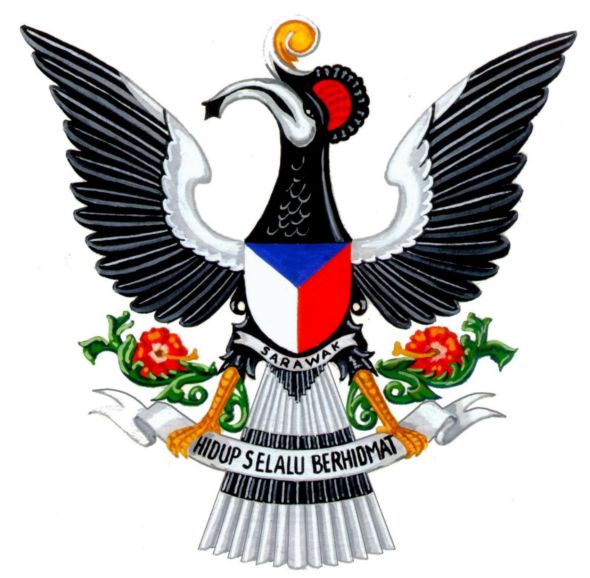
The Trisakti was adopted on the 10th anniversary of Sarawak's independence in 1973, and was first hoisted by the then Chief Minister of Sarawak, Abdul Rahman Ya'kub who also designed the flag. Accompanying the new design of the flag is the new state anthem and motto, Sarawak Bahagia and Hidup Selalu Berkhidmat ("Live to serve").

In 1988, the flag was replaced again with the current version along with yet another new state anthem and motto, Ibu Pertiwiku and Bersatu, Berusaha, Berbakti ("United, Striving, Serving"). The new design was adopted on the 25th anniversary of independence of Sarawak within Malaysia.